

I remember when...
London was marginally cheaper.

I don’t want to be one of those boring old millennials who moans about how things used to be, but I’m going to.
I’ve watched and listened to “older people” chatting about the way things used to be since I was a teenager, and I remember thinking, well, I quite like it right now—I’m not sure why your old brain is struggling with change so much. I told myself I wouldn’t be like that; I’d always embrace the new.
That being said, when the “new” is slow strangulation by the hands of capitalism, then maybe I don’t embrace it. Maybe I want some old stuff back.
I was chatting to another working-class friend of mine, and we shared tales of struggling to live in London when we were younger. It added to the already growing plethora of thoughts I’ve been having over the last few years.
As I sit on my golden throne (my flat that I own with my partner), I look around—especially in the area I live in—and can’t help but wonder how young people could afford to live here now.
A bit of context: my family are your classic working-class people. Mum worked as an administrator; Dad was an electrician until he became disabled before the age of 30 and had to claim disability allowance to live. There was zero cultural capital in my family. We just loved karaoke and caravan holidays—a bit of Bat Out of Hell in the Mini Metro, Mum chonging a cig in the depths of January with the windows up, smoking us out.

We grew up sensitive to even minor class indicators. Once, my mum took us for piano lessons in Kettering, and the teacher had a vibe we couldn’t quite understand. She had a harpsichord in the house and what can only be described as a totally lopsided bob. When I asked who cut her hair, she replied, “Me,” and I said, “I could tell.” My mum said we weren’t allowed to go back.
(On a side note, we also had trouble with the next piano teacher because, even though I quite liked him, my sister did not. We turned up to our first lesson and he said, jokingly, to my sister, “Oh, you’ve spilled something down your top—we need to get you some Persil”. In response, she swept the dandruff from his shirt and said, “and we need to get you some Head & Shoulders.” We weren’t allowed to go back there either.)
Mum did try, but it was in vain. None of us knew what we were doing in that world. Best we stay out.
I tried really hard to assimilate when I got to London, but I honestly couldn’t work out how to. My family deals exclusively in taking the piss, being funny, and trying to be right—all of which have crept into my personality. In some ways they’ve helped, and in lots of other ways they really haven’t. I don’t think I was ever taken seriously, but part of that is because I hadn’t taken myself seriously either.
People seemed quite serious in this new world of London. I’d come from working in factories—I’d spent a year doing it full-time so I could get to London—so when I got here and worked in an office (a call centre, inbound only, mind you), I felt like a fish out of water, ready to be caught out for who I really was: a girl with two GCSEs who was very bad on the phone.
A normal phone call from my Mum would consist of her telling me my Step Dad had been sent home from work because there had been an accident, and the cheesy balls machine had blown up in Golden Wonder and covered him in extruded corn. So, working in a place that had an international department felt quite posh.
They do talk about the “school of life” (an offensive term, if you ask me, but one that’s been said about me many times), but there’s a grain of truth in there. I was just continuously learning from my mistakes. I would put people on mute and talk about them; I would then hear, “I can hear you, you know,” and I’d put the phone down. I learned not to do an icebreaker about Jimmy Savile. I learned that women seem to have a professional work dress code that men often don’t (I got a disciplinary for having a skirt above my knee—what is this, 1890?). I learned that if you want to work in a professional setting, you do, sadly, need to make yourself much, much smaller.
It took me a really, really long time to work that out, and I guess this is what I mean about having zero cultural capital. I didn’t come from a “professional” world; it’s not how I grew up. I grew up in a pub, and although I feel quite socially capable, I’ve often found myself feeling like an alien to others.
I currently live in Stoke Newington, the heartland of gentrification. I’m one of them. I may be from a working-class background, but I certainly live in a middle-class world. This too can be strange sometimes, as I’m not hugely accepted as middle class either—I often stand out because of my vocabulary, accent, or the way I interact.
I feel very lucky that I came to London when I did, in 2008. My rent was £400, with an actual living room and garden; my wage was £18k. I used to go to the big Topshop on Oxford Street, buy some ugly ass outfit, wear it for two weeks, then unpick the stitching and take it back. I did this on rotation (fuck you, Philip Green). There are pictures of me from this era in different clothes all the time, but if you opened my cupboard, a moth would fly out. I lived off older men at work buying rounds at the pub, Sainsbury’s own rum, and tins of beans (we called it “beanfeast”—it felt fancier).
I lived my life to the fullest in those years. We begged, borrowed, and… maybe stole (actually, I don’t think we stole—maybe an ashtray or two from the pub and my friend did nick a loaf of bread from an open Hovis van that was unloading once). Anything seemed possible. My best mate got a job in music advertising, so we went to free gigs, snuck in booze, and let older people buy us drinks five nights a week.
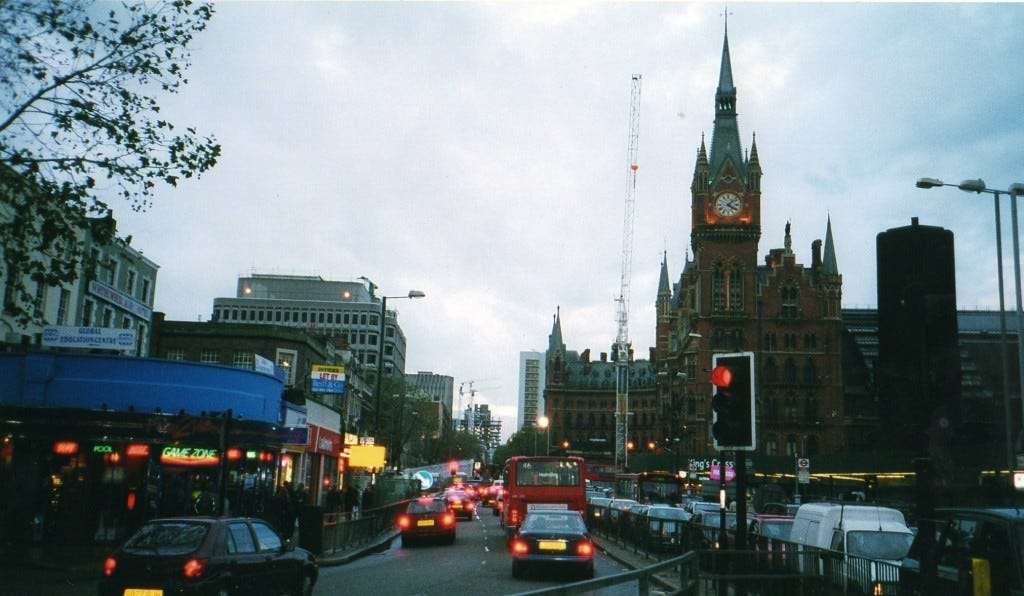
Now I see young people in this area, and I know the rent is over £1,000 just for a bedroom. I have literally no idea how they are doing that. Either they all have insanely well-paid jobs (in a stagnant market, I’d be surprised), or there’s help from parents. No shade. If your parents can provide, then take it. But I do worry, and feel quite sad, about the working-class kids from towns outside London who want to come and experience life in the big city, even if it’s just to decide it’s shit and move somewhere else.
The call centres have all moved away from London, the pints are getting more expensive, small plates happened (time to fuck off), and a chippy will cost you £15. I’m not sure how you live here on an entry-level salary anymore. Obviously, I blame rampant capitalism.
But I’m seeing the area I live in—I’ve been in Hackney for 11 years and Haringey before that for five—become more and more exclusive. I know this is gentrification. I know I’m part of the problem. I feel immensely privileged to come from the background that I do and to be living the lifestyle I am, but even then I’m surrounded by establishments that I can’t afford to visit.
I do miss the ragged opportunity that existed 18 years ago. If I’m struggling to stay here at my age, how do young people stand a chance if they don’t have help?
Did children play outdoors? Do they still play outside?